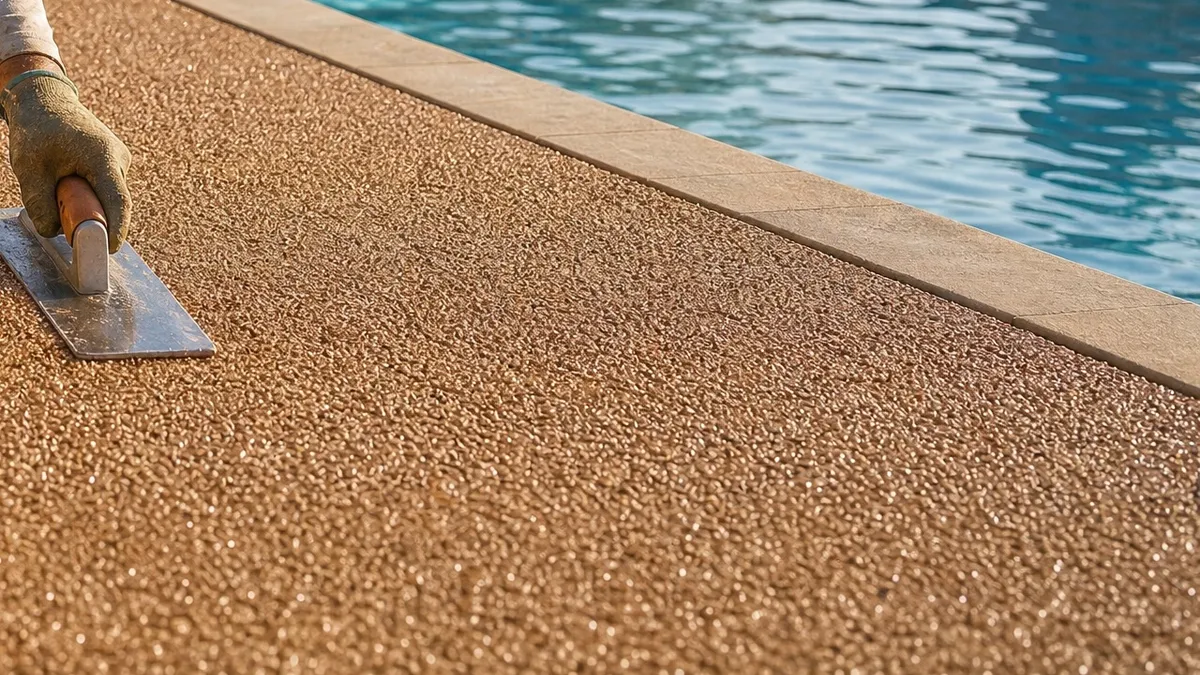
Poured-in-place rubber surfacing is a site-applied outdoor finish used in a range of residential and commercial settings. It can be shaped around curves and irregular layouts rather than arriving as a pre-made mat or tile.
Now this same category of surfacing has become a popular choice for residential backyards across the Dallas-Fort Worth Metroplex.
At Affordable Rubber Surfacing, we get regular questions from homeowners about exactly what this material is and how it works. In this guide, we define poured-in-place rubber, explain the installation process, and outline where it fits in a Texas outdoor living space.
Defining Poured-in-Place Rubber Surfacing
Poured-in-place (often abbreviated PIP) rubber surfacing isn’t a mat, a tile, or a roll of material that gets glued down. It’s a custom-mixed, site-applied surface.
Definition: Poured-in-place rubber surfacing is a site-applied system in which rubber granules are mixed with a polyurethane binder and hand-troweled over a suitable prepared base. The finished texture, drainage behavior, and suitability depend on the material system, preparation, and site conditions.
Because it is mixed and hand-troweled on site, it can be shaped to fit curves and irregular dimensions with fewer finish seams than a tile or paver layout.
The Components: What Goes Into the Mix?
1. Premium TPV Granules
The visible surface ARS installs uses TPV (Thermoplastic Vulcanizate) rubber granules. ARS specifies TPV for its outdoor projects rather than EPDM. Ask any installer to identify the complete granule-and-binder system proposed for the site.
2. Polyurethane Binder
The binder holds the rubber granules together. ARS uses an aliphatic polyurethane resin as part of its specified system. The base must still be suitable: an overlay does not repair active structural movement or failing concrete.
The Installation Process
One advantage of poured-in-place rubber is that it can often be installed directly over existing concrete, avoiding the expense and mess of demolition.
- Site Preparation — we inspect and prepare the existing surface, review cracks and edges, and assess drainage.
- Priming — a primer is applied to the concrete to support adhesion between the old surface and the new rubber.
- Custom Mixing — TPV granules (in your chosen color blend) and liquid binder are measured and mixed on-site.
- Hand-Troweling — technicians spread the rubber mixture over the primed surface, hand-troweling it to a smooth, uniform thickness.
- Curing — the surface cures undisturbed. Cure and return-to-use timing depends on weather, humidity, and project scope, and we’ll walk you through the specific plan for your site.
For more detail, visit our Poured-in-Place FAQ.
Where Can PIP Rubber Be Installed?
- Pool decks, patios, and outdoor kitchens — when the existing base and project conditions are suitable.
- Outdoor venue and amenity spaces — after evaluating intended use, access, drainage, and the base.
- Play areas and athletic or gym spaces — where the required system, depth, and any applicable project specifications have been confirmed.
Why DFW Homeowners Are Considering the Switch
The move toward PIP rubber in North Texas is driven by the region’s environmental challenges. Standard concrete cracks as soil moves. Dark pavers can get hot in summer. Acrylic coatings peel and require repainting.
Poured-in-place TPV rubber may be worth evaluating when the goal is to refresh a suitable existing outdoor surface. The right recommendation depends on the base condition, drainage, exposure, use, and the material system—not on a one-size-fits-all performance claim.
Transform Your Backyard
If you’re tired of looking at worn concrete or are considering a new surface around your pool, it may be worth discussing whether poured-in-place rubber is appropriate for your property.
Contact Affordable Rubber Surfacing to explore our custom TPV color blends and discuss your project.
Schedule Your Free Consultation Today
Frequently Asked
Is poured-in-place rubber porous?
Drainage depends on the selected system, base, slope, and installation details. ARS reviews the existing drainage conditions before recommending an outdoor overlay.
Can it be installed over dirt or grass?
No. Poured-in-place rubber needs a solid, stable substrate — such as concrete, asphalt, or tightly compacted crushed stone — to bond properly and maintain structural integrity.
How do I choose the right color?
We offer a range of TPV granule colors that can be blended in different combinations. During your consultation, we'll help you design a custom blend that complements your home's aesthetic.
Is it safe for pets?
It can be considered for pet-friendly outdoor spaces because it creates a textured, cushioned surface. Ask about the exact material system and cleaning routine for your pet's use of the area.
See If Rubber Surfacing Is Right for Your Project
Share your contact info below — Affordable Rubber Surfacing will follow up by text for project photos and details, then schedule a free consultation.