
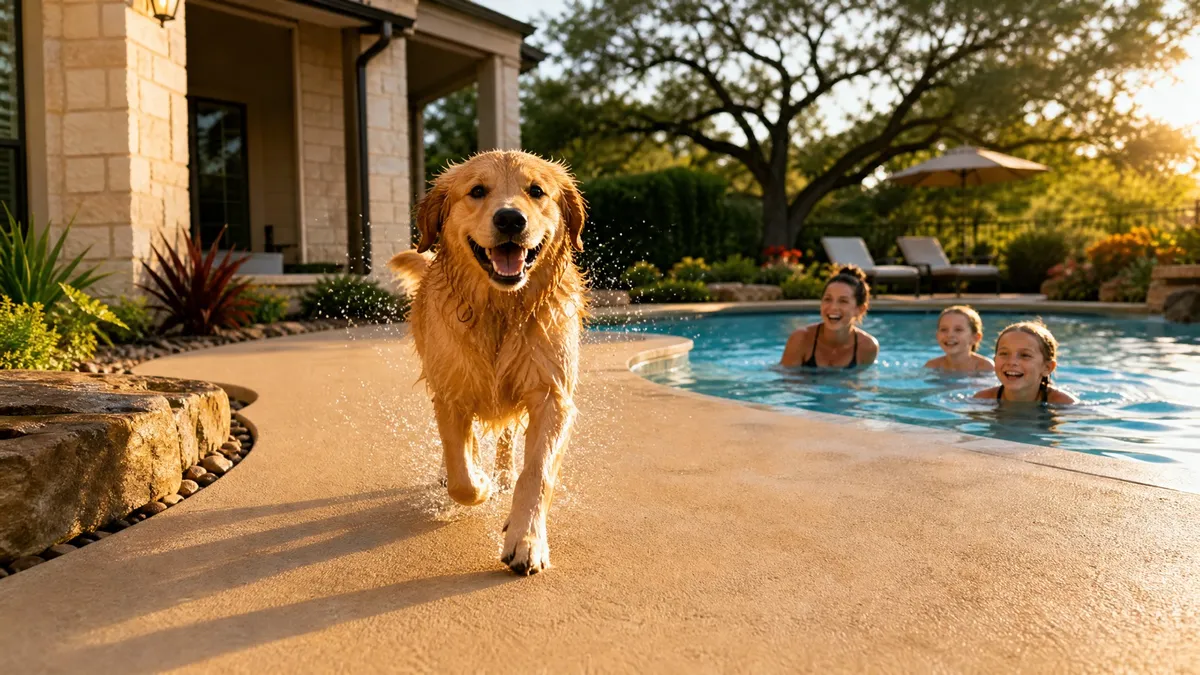
In Texas, our dogs are family. Whether you own a Golden Retriever, a rescue mutt, or a French Bulldog (one of the most popular breeds in Dallas [1]), you want them to enjoy your backyard as much as you do.
But during a Dallas-Fort Worth summer, your pool deck can hide a danger that most homeowners overlook: surface temperature.
While you might step outside in sandals or hop straight from a towel into the water, your dog’s paws are fully exposed. At Affordable Rubber Surfacing, we regularly hear from pet owners looking for a way to make their pool decks safer for their dogs. Here’s what’s actually happening with hot pavement in Texas, and why TPV rubber surfacing is worth a look.
How Hot Does Pavement Actually Get?
Homeowners often underestimate how hot concrete and traditional pool decking get under direct Texas sun.
When the air temperature is a comfortable 86°F, asphalt and dark concrete can reach as high as 135°F [2]. In the DFW Metroplex, where summer air temperatures routinely exceed 100°F, surface temperatures on traditional concrete pool decks can climb well beyond that.
For reference, veterinary sources note that pavement around 125°F can cause skin damage to paw pads in as little as 60 seconds [3].
Because dogs regulate heat partly through their paws, walking on a hot deck isn’t just a burn risk — it also makes overheating worse.
The 7-second test: A commonly cited rule of thumb is to place the back of your bare hand on the deck. If you can’t comfortably hold it there for seven seconds, it’s too hot for your dog’s paws.
The Problem with Traditional Pool Decks
Standard concrete, stamped concrete, or stone paver pool decks tend to create a few recurring problems for dog owners:
- Heat retention. Dense materials like concrete absorb heat all day and hold onto it well into the evening, so the deck can stay hot after the sun goes down.
- Slippery when wet. Wet paws have little traction on smooth concrete or sealed pavers, which can lead to slips.
- Abrasive surfaces. Rough, brushed concrete can wear down paw pads over time, especially with dogs that run and play often.
Hosing down the deck before letting the dog out helps briefly, but the water evaporates within minutes and the surface heats back up.
Why TPV Rubber Surfacing Is Worth Considering for Pet Owners
TPV (thermoplastic vulcanizate) poured-in-place rubber is a seamless surface hand-troweled directly over your existing deck. A few things make it a strong fit for households with dogs:
1. Better Heat Behavior
TPV rubber doesn’t absorb and hold heat the way concrete does. Lighter, custom color blends (tans, light grays, creams) reflect more solar radiation, which helps the surface stay more comfortable underfoot, including for paws, even in August.
2. Slip Resistance
Whether your dog is jumping in and out of the pool or running around the patio, traction matters. TPV rubber has a naturally grippy, textured surface that gives wet paws — and wet human feet — better stability than smooth concrete or pavers.
3. Cushioning
As dogs age, running and jumping on hard concrete adds wear on their joints. The elasticity of poured-in-place rubber provides a softer landing surface and avoids the abrasive texture of rough concrete.
4. Easy to Clean
Because TPV rubber is a seamless surface, it has no grout lines between individual pavers. A rinse with a garden hose or a mild cleaner appropriate for the system can help with routine cleanup; ask ARS for project-specific care guidance.
Comparing Pool Deck Surfaces for Pets
| Feature | TPV Rubber Surfacing | Traditional Concrete | Stone Pavers | Kool Deck / Spray |
|---|---|---|---|---|
| Heat Retention | Lower | High | High | Moderate |
| Wet Traction | Better | Poor | Poor | Moderate |
| Cushioning | Yes | None | None | None |
| Paw Pad Wear | Minimal | Higher (abrasive) | Moderate | Higher |
Protect Your Dog This Summer
You shouldn’t have to keep your dog off the deck or worry every time they want to join the family by the pool. If your current deck runs hot, is slippery when wet, or is rough on paws, it may be worth talking to us about whether a rubber overlay fits your backyard.
Schedule Your Free Consultation Today
References
[1] Dogster. “16 Pet Ownership Statistics in Texas.” https://www.dogster.com/statistics/pet-ownership-statistics-in-texas/
[2] Four Paws USA. “Hot Asphalt – A Danger to Your Dog’s Paws.” https://www.fourpawsusa.org/our-stories/publications-guides/hot-asphalt-a-danger-to-your-dogs-paws
[3] Stanislaus Animal Services. “Too Hot to Walk Flyer.” https://www.stanislausanimalservices.com/pdf/2_hot_2_Walk.pdf
Frequently Asked
Can my dog's nails scratch or tear the rubber surfacing?
TPV poured-in-place rubber is designed to hold up to regular foot traffic, patio furniture, and active pets. As with any outdoor surface, wear depends on the installed system, your dog's size and activity level, and maintenance; ARS does not promise a universal scratch- or tear-proof outcome, and can discuss project-specific durability expectations during your evaluation.
Is the rubber material toxic if my dog licks it?
Ask about the exact material system and how the finished surface fits your pet's use of the space. ARS does not make a blanket medical or product-safety claim without project-specific material documentation.
Will pet urine stain the rubber surface?
The surface is resilient and shouldn't stain or degrade if rinsed off in a reasonable time. We recommend hosing off the area as part of normal deck maintenance.
Do I have to tear out my current concrete to install this?
No — TPV rubber is poured directly over your existing, stable concrete or paver deck. There's no demolition involved, and installation is typically finished in just a few days.
See If Rubber Surfacing Is Right for Your Project
Share your contact info below — Affordable Rubber Surfacing will follow up by text for project photos and details, then schedule a free consultation.