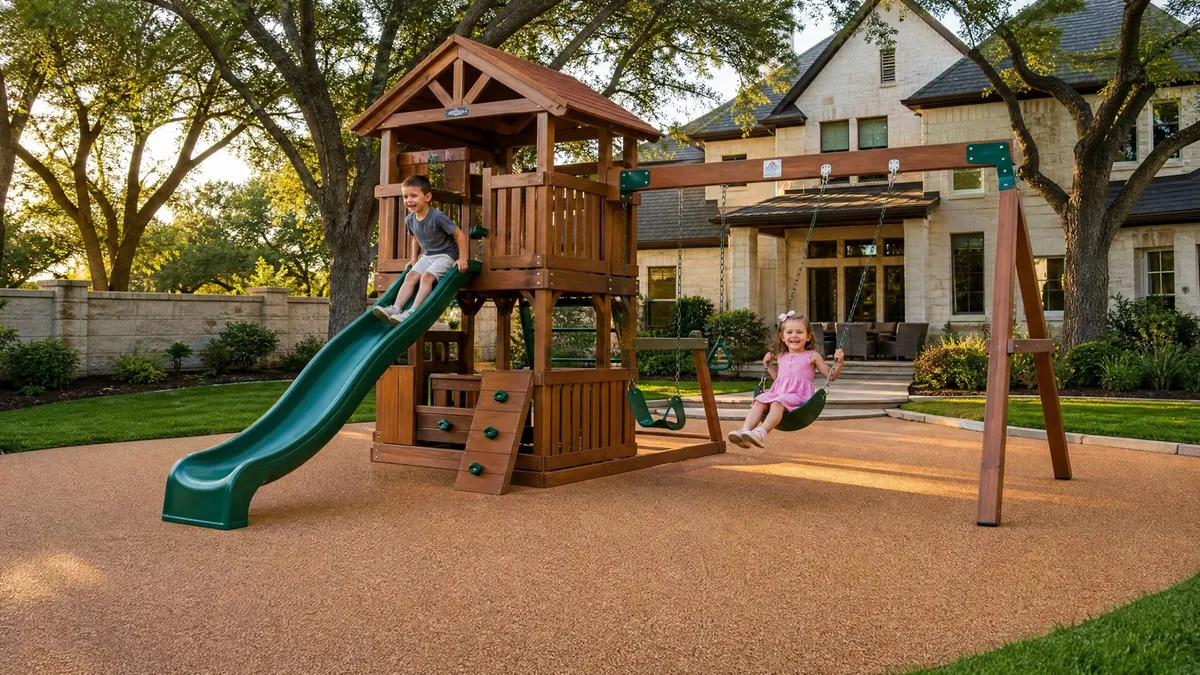
Daycares, schools, HOA amenities, and municipal parks across Dallas-Fort Worth all share the same underlying question when a playground surface starts to show its age: what should replace worn mulch, cracked concrete, or aging rubber tile, and what does the replacement need to account for that a backyard project doesn’t?
At Affordable Rubber Surfacing, we work with property managers, HOA boards, and facility directors evaluating poured-in-place TPV rubber surfacing for commercial and institutional play areas. This guide covers what a commercial evaluation should include.
Why Commercial Playground Surfacing Is a Different Project
A backyard play set typically has one piece of equipment and light, intermittent use. A daycare, school, or HOA playground usually has several equipment zones, higher daily traffic, and more people relying on the surface performing consistently. That changes what the evaluation needs to cover:
Multiple Fall-Height Zones
Different equipment (swings, climbers, slides) can have different fall-height needs. The U.S. Consumer Product Safety Commission’s Public Playground Safety Handbook identifies protective surfacing as a factor in reducing injury risk from falls, and recognizes several material categories, including rubber, that can contribute to impact attenuation when the system is designed and installed correctly [1]. The handbook does not certify a single product; system depth, base, and installation determine performance, so each zone should be evaluated on its own equipment.
Traffic and Wear
Daily use by dozens or hundreds of children puts more cumulative wear on a surface than occasional residential use. The scope should account for expected traffic when specifying system thickness and maintenance planning.
Access and Scheduling
Commercial sites often need work sequenced around school hours, daycare operating schedules, or HOA amenity availability. ARS provides a project-specific timeline rather than a generic estimate, and can discuss phased or off-hours work where it fits the site.
Procurement and Documentation
Schools, municipalities, and HOA boards frequently need a documented scope, material specification, and warranty terms for board approval or procurement records. ARS can provide that documentation as part of a commercial proposal.
What to Evaluate Before Choosing a System
- Existing base condition — concrete, asphalt, or another hard surface in stable condition, versus one needing repair or leveling first.
- Equipment layout and fall heights — each zone’s equipment determines the surfacing depth needed there.
- Drainage — standing water after rain affects both safety and surface longevity.
- Traffic patterns — how many children use the space, and how often.
- Access for installation — gates, equipment staging, and how the site will operate during the project.
A Note on Compliance Claims
No responsible installer should promise that a material alone satisfies ASTM, CPSC, or ADA accessibility requirements without reviewing the specific equipment, fall heights, and site design. ARS discusses fall-height and system-design needs project by project and does not issue blanket compliance guarantees; if your facility requires documented compliance for insurance, licensing, or procurement purposes, say so during your evaluation so it can be addressed directly.
Planning a Commercial Playground Resurfacing Project
If your daycare, school, or HOA is evaluating a playground surface replacement, ARS can review your site, equipment, and requirements and discuss whether poured-in-place rubber surfacing is a fit.
Schedule Your Free Commercial Consultation Today
References
[1] U.S. Consumer Product Safety Commission. “Public Playground Safety Handbook.” https://www.cpsc.gov/Playground-Handbook
Frequently Asked
Does poured-in-place rubber meet playground safety standards?
No single material category automatically meets a specific standard on its own. Compliance depends on the complete system design — thickness, base preparation, and equipment fall-height requirements — evaluated for your specific site. ARS can discuss fall-height needs and system design during your evaluation; we don't promise a universal compliance rating without that review.
How does commercial playground surfacing differ from a backyard installation?
Commercial sites (daycares, schools, HOA amenities, municipal parks) typically see higher daily traffic, need to account for multiple equipment zones and fall heights, and often have specific procurement, access, or scheduling requirements. ARS scopes commercial projects around those factors rather than treating them as a larger version of a residential job.
Can you install around existing playground equipment without full replacement?
In many cases a poured-in-place system can be installed around existing, suitable equipment. Whether that fits your site depends on the current base, drainage, and equipment condition, which ARS reviews before proposing a scope.
How do you minimize downtime for a school or daycare?
ARS provides a project-specific timeline based on square footage, prep needed, and site access, and can discuss phasing or off-hours work to reduce disruption. We don't offer a universal downtime figure that ignores your site's actual scope.
See If Rubber Surfacing Is Right for Your Project
Share your contact info below — Affordable Rubber Surfacing will follow up by text for project photos and details, then schedule a free consultation.