If you’ve searched “patio resurfacing,” you’ve probably found two very different answers: a $30 bag of concrete resurfacer at the hardware store, and a full professional overlay system. Both are real options — but they solve different problems.
At Affordable Rubber Surfacing, we regularly talk to DFW homeowners who tried a DIY product first, or who are trying to decide whether they even need to. Here’s an honest look at both paths.
What DIY Concrete Resurfacer Kits Actually Do
Products like concrete resurfacers are thin cementitious coatings, typically rolled or trowel-applied over an existing slab. They’re designed to:
- Refresh the cosmetic appearance of a faded or lightly worn slab.
- Fill very fine surface imperfections (not structural cracks).
- Give a slab a new color or texture at a low material cost.
Where they fall short: thin coatings don’t fix drainage problems, don’t bridge active cracks reliably, and wear unevenly under regular foot traffic, furniture, and Texas sun and rain cycles. Reapplication every few years is common, and DIY application quality varies a lot based on surface prep and weather during cure.
When DIY Resurfacing Makes Sense
A DIY product can be a reasonable choice when:
- The existing slab is structurally sound with only light cosmetic wear.
- You’re comfortable with a shorter-term refresh and possible reapplication.
- Budget is the primary constraint and the patio sees light use.
When to Consider a Professional Overlay Instead
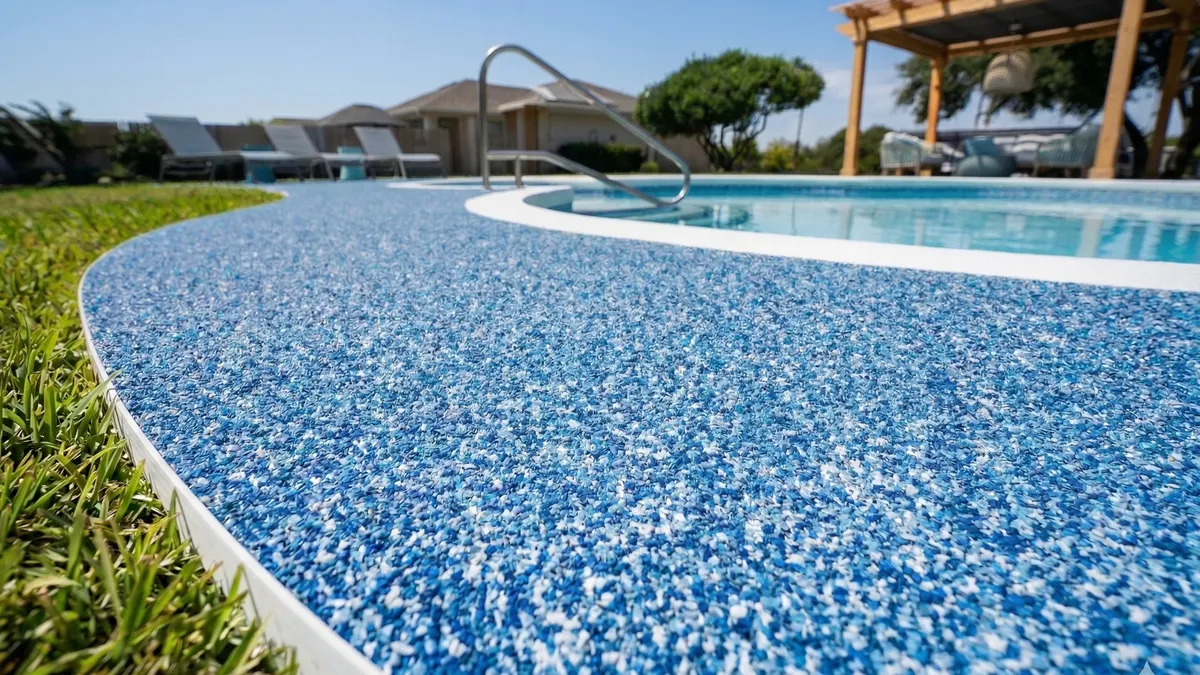
A professional overlay system — including poured-in-place TPV rubber — is a different scope, not a bigger version of a DIY kit. It’s worth evaluating when:
- The slab has real cracking, uneven areas, or drainage problems a thin coating can’t address.
- You want a seamless, hand-troweled finish rather than a rolled coating.
- The patio gets heavy daily use — pets, furniture, grilling, entertaining — and you want a system built for that traffic rather than a cosmetic refresh.
- You’ve already tried a DIY product and it didn’t hold up.
Our cheap rubber surfacing red flags guide covers a related trap: even among “professional” quotes, material and prep quality vary enormously, so a low bid isn’t automatically a good deal either.
Comparing the Two Paths
| Factor | DIY Concrete Resurfacer | Professional TPV Rubber Overlay |
|---|---|---|
| Upfront cost | Lower | Higher |
| Fixes cracks or drainage | No | Addresses base prep and drainage as part of the scope |
| Application | Homeowner, weekend project | Trained installers |
| Typical durability | Reapplication often needed within a few years | Depends on system and site; ARS reviews project-specific care |
| Finish | Thin cosmetic coating | Seamless, textured surface |
Deciding What’s Right for Your Patio
The honest first step is figuring out what’s actually wrong with your current patio. A worn but structurally sound slab is a different project than a cracked, poorly-draining one. Our resurface vs. replace guide walks through that distinction in more depth (it’s written for pool decks, but the same logic applies to patios).
If you’d rather have someone look at your specific slab than guess from a product label, ARS can evaluate your patio and tell you plainly whether a rubber overlay fits — including if it doesn’t.
Schedule Your Free Consultation Today
Frequently Asked
Does concrete patio resurfacing actually work?
It can, for the right problem. Thin resurfacing products are designed to refresh the cosmetic layer of a stable slab; they are not a fix for a structurally cracked or actively moving slab. Whether resurfacing (of any kind) works for your patio depends on the condition underneath it.
Can I resurface my own concrete patio?
DIY concrete resurfacer kits exist and can be applied by a homeowner. Results depend heavily on surface prep, weather during cure, and application technique, which is why DIY outcomes vary widely. A professional overlay is a different scope and material system, applied by trained installers.
What's the downside of a DIY concrete overlay?
Thin DIY coatings can show trowel marks, wear unevenly in high-traffic areas, and need reapplication every few years. They also don't address drainage, existing cracks, or heat, which is why some homeowners look at overlay systems instead after a DIY product doesn't hold up.
How long does patio resurfacing last?
It depends entirely on the product, prep, and installation. ARS does not promise a universal lifespan for any surface; the right question to ask any installer, DIY or professional, is what specifically affects longevity for the product being used.
How do I find a patio resurfacing company near me in DFW?
Ask any local installer for their specific material system, base preparation process, and warranty terms before comparing price alone. ARS serves the Dallas-Fort Worth Metroplex, including combined pool-deck-and-patio projects, and can evaluate your specific site.
See If Rubber Surfacing Is Right for Your Project
Share your contact info below — Affordable Rubber Surfacing will follow up by text for project photos and details, then schedule a free consultation.