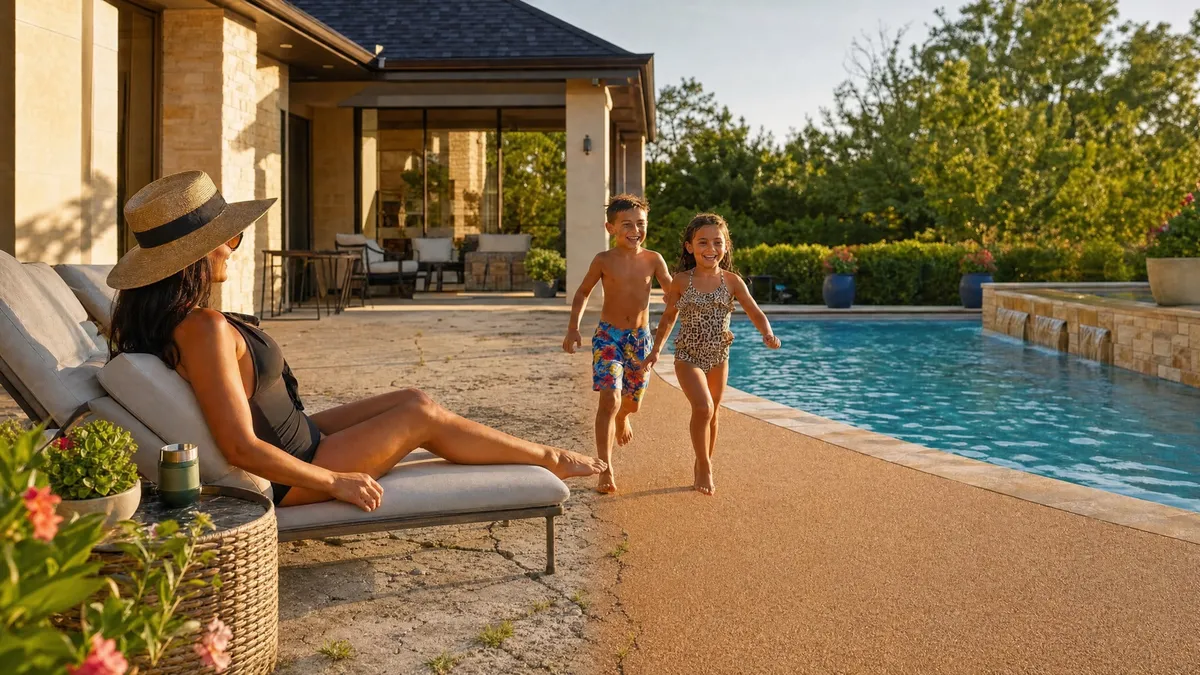
If you own a home in the Dallas-Fort Worth Metroplex, you’re likely familiar with the challenges of expansive clay soil. The cycle of shrinking during summer droughts and swelling during heavy rains wreaks havoc on concrete structures. For pool owners, this can lead to a frustrating problem: a cracked, shifting, uneven pool deck.
Traditionally, fixing a severely cracked pool deck meant one thing: demolition. Jackhammers, dust, noise, and weeks of a backyard turned into a construction zone, followed by the expense of pouring new concrete.
There’s a modern alternative. At Affordable Rubber Surfacing, we help DFW homeowners evaluate whether they can bypass demolition by installing TPV poured-in-place rubber surfacing directly over existing, damaged concrete — when the base is a good candidate.
The Problem with Patching and Painting
When cracks first appear, many homeowners attempt a DIY fix or hire a contractor to apply a patch and a fresh coat of acrylic paint (often called “Kool Deck”).
This may be a temporary fix if the underlying condition is still changing.
Because the underlying soil continues to move, the rigid concrete can shift again. When it does, a brittle patch can crack and paint can peel. Painted concrete also remains hard and can be slick when wet.
The Poured-in-Place Rubber Approach
Poured-in-place rubber surfacing is fundamentally different from rigid coatings. It’s a seamless, flexible matrix of TPV rubber granules and binder resins.
When it can work: A rubber overlay may be considered when the existing base is stable and the crack pattern, drainage, edges, and repairs have been evaluated. It is not a structural fix for active movement, major voids, or failing concrete.
The Installation Process
- Surface Preparation — we evaluate and prepare the existing concrete, then address appropriate surface repairs and drainage details before an overlay is installed.
- Priming — a primer is applied to the concrete to support adhesion.
- Mixing — TPV rubber granules and binder are measured and mixed on-site.
- Troweling — our technicians hand-trowel the rubber mixture over the prepared concrete, bridging filled cracks and creating a seamless surface.
- Curing — the surface cures, forming a bond with the concrete below. We’ll walk you through the project-specific cure and return-to-use timeline.
For more detail on our methodology, visit our Poured-in-Place FAQ.
Benefits Beyond Crack Repair
Resurfacing with TPV rubber changes the appearance and finish of a suitable pool area. The evaluation should cover these practical considerations:
- Texture and drainage — discuss how the selected system is specified for the actual pool-deck conditions.
- Base condition — confirm which repairs are required before an overlay can be considered.
- Heat and exposure — review samples in the intended location; no outdoor finish stays cool in direct Texas sun.
- Aesthetic Refresh — custom color blends let you refresh your backyard’s look without a full remodel.
When Is Demolition Actually Required?
Rubber surfacing can be a strong option for many cracked decks, but it isn’t a fit for every situation. The existing concrete needs to be structurally stable enough to serve as a base.
If your concrete has severe heaving, major structural voids, or is actively crumbling, it may need partial or full replacement before a new surface can be applied. During your initial consultation, we’ll evaluate your deck honestly to determine whether it’s a candidate for resurfacing.
Save Time and Disruption
A cracked pool deck doesn’t have to mean a demolition project. Contact Affordable Rubber Surfacing to learn whether your damaged concrete is a candidate for a TPV rubber overlay.
Schedule Your Free Consultation Today
Frequently Asked
Will the cracks in my concrete eventually show through the rubber?
No installer can promise that movement-related cracks will never affect an overlay. ARS evaluates whether cracks appear cosmetic and stable or whether the base needs repair before an overlay is considered.
How thick is the rubber surface?
For standard pool deck resurfacing over concrete, the rubber layer is typically installed at a thickness that balances durability and cushioning, confirmed during your project evaluation.
Can rubber be installed over stamped concrete or pavers?
Often, yes, as long as the stamped concrete or pavers are structurally sound and stable. We evaluate the surface before recommending a rubber overlay.
How long does the installation take?
Timing depends on the size of the deck and the amount of preparation required. We provide a project-specific installation timeline during your evaluation.
See If Rubber Surfacing Is Right for Your Project
Share your contact info below — Affordable Rubber Surfacing will follow up by text for project photos and details, then schedule a free consultation.