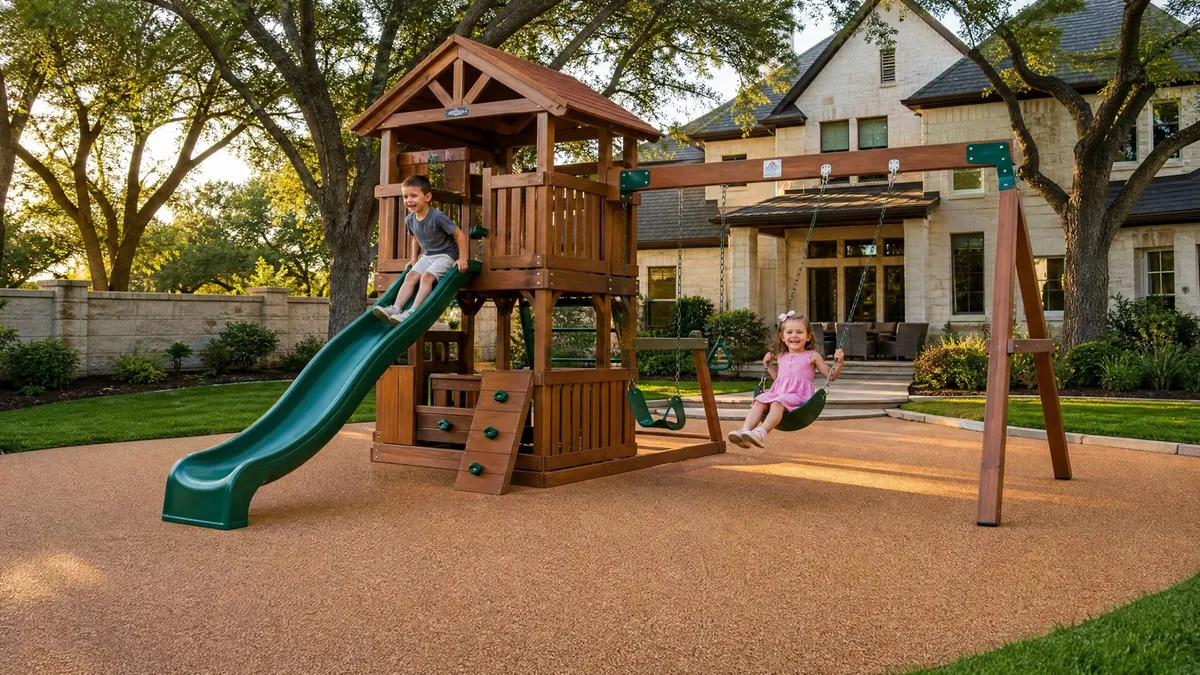
Building a backyard playground is an exciting project for any Dallas-Fort Worth family. Whether you’re installing a large wooden playset or a simple swing set, the equipment, site conditions, and surface beneath it all need to be considered together.
Affordable Rubber Surfacing installs TPV poured-in-place rubber surfacing for suitable residential play areas. This guide compares common surface types so you can identify the questions to resolve before selecting a system.
Why the Ground Surface Deserves a Project-Specific Review
Falls are one of the most common playground injury patterns, and the U.S. Consumer Product Safety Commission’s Public Playground Safety Handbook identifies protective, impact-attenuating surfacing under and around equipment as a key factor in reducing the risk of severe injury from those falls [1]. The handbook recognizes several material categories, including shredded/recycled rubber, as options that can help attenuate impact when installed and maintained correctly.
That said, the surface beneath play equipment should be evaluated with the equipment layout, intended users, drainage, substrate, and any applicable project requirements. Do not assume that any product or material alone meets a specific safety, accessibility, or fall-height standard — attenuation performance depends on the system design, depth or thickness, and installation, not the material category alone.
Comparing Backyard Playground Surfaces
Grass
Pros: Low cost, familiar, visually soft.
Cons: Grass compacts and thins out under repeated use, especially beneath swings and slides, and can become nearly as hard as bare dirt in high-traffic zones. It also doesn’t hold up well to Texas summer heat and drought.
Wood Chips or Mulch
Pros: Familiar, landscape-like appearance.
Cons: Requires regular replenishment as material compacts, decomposes, or gets displaced. Its suitability depends on installation, upkeep, equipment, and site conditions.
Rubber Mulch
Pros: Loose-fill option that can fit some contained play areas.
Cons: Can still migrate and requires depth maintenance; loose material can be tracked into the house.
Poured-in-Place TPV Rubber Surfacing
Pros: A fixed, hand-troweled surface with no loose material to redistribute. It can be considered around suitable prepared bases, play structures, borders, and drainage details.
Cons: Higher upfront cost than loose-fill materials; requires a stable substrate and professional installation.
How Much Does Playground Rubber Surfacing Cost?
This is the first question most DFW families ask, and the honest answer is that it depends on more than square footage alone. A quote reflects:
Square Footage and Depth
Larger areas and thicker systems (needed for taller equipment with a greater fall height) both increase material and labor cost.
Existing Base Condition
A stable, well-drained concrete or asphalt base is faster and less expensive to build on than a surface that needs prep work, leveling, or drainage correction first.
Color and Design
A single-color system is typically simpler to install than multi-color blends, borders, or inlaid patterns.
Site Access
How easily equipment and material can reach the work area affects labor time.
Because of these variables, ARS quotes playground projects after reviewing photos, square footage, and equipment details — not with a flat per-square-foot number that would have to ignore your actual site.
Rubber Surfacing vs. Mulch vs. Gravel: A Quick Comparison
| Factor | Poured-in-Place Rubber | Rubber Mulch | Gravel / Wood Chips |
|---|---|---|---|
| Upfront cost | Higher | Moderate | Lower |
| Long-term upkeep | Low (fixed surface) | Periodic topping-off | Regular replenishment |
| Migrates or tracks indoors | No | Can migrate | Yes |
| Substrate required | Concrete, asphalt, or compacted stone | Contained bed | Contained bed |
| Surface feel | Seamless, consistent | Loose | Loose, can compact |
The cheapest option up front (gravel or wood chips) isn’t necessarily the cheapest over several years once replenishment and labor are factored in — the right trade-off depends on your budget and how much ongoing maintenance you want to take on.
What to Evaluate for Your Play Area
- What age groups will use the space?
- Is there playground equipment with specific fall-height considerations?
- Is the current base concrete, soil, or an existing hard surface?
- Does water stand anywhere after rain?
- How soon do you need the area back in service?
Choosing a Surface for Your Play Area
If your backyard playground surface is patchy grass, worn mulch, or bare dirt, it may be worth evaluating whether a poured-in-place rubber surface is a good fit for your family’s play area. ARS will first review the existing base, equipment, drainage, and project requirements.
Contact Affordable Rubber Surfacing to discuss your backyard playground project.
Schedule Your Free Consultation Today
References
[1] U.S. Consumer Product Safety Commission. “Public Playground Safety Handbook.” https://www.cpsc.gov/Playground-Handbook
Frequently Asked
Is poured-in-place rubber good for backyard playgrounds?
It can be considered when a seamless, fixed surface suits the site and project needs. Equipment, age groups, drainage, substrate, and any fall-height or accessibility requirements must be evaluated as a complete project.
Is rubber surfacing better than mulch or wood chips?
Neither is automatically better. A poured-in-place system may fit projects that prioritize a fixed, continuous surface, while loose-fill options may suit other budgets and maintenance expectations. The actual site and requirements determine the appropriate choice.
Can rubber surfacing go over grass or dirt?
No. It requires a solid, stable substrate like concrete, asphalt, or tightly compacted crushed stone to bond and perform correctly.
Does ARS guarantee a specific safety rating?
We don't promise a universal compliance rating without a project-specific system design. We can discuss fall-height needs and appropriate surfacing design during your evaluation.
How much does playground rubber surfacing cost per square foot?
Cost depends on square footage, existing base condition, thickness/depth needed for the equipment's fall height, drainage work, color/design, and site access. ARS provides a project-specific quote after reviewing photos and details rather than a flat per-square-foot rate that ignores those variables.
Is rubber mulch cheaper than poured-in-place rubber?
Loose-fill rubber mulch typically costs less upfront than a poured-in-place system, but it needs periodic topping-off, can migrate or get tracked indoors, and doesn't create a fixed, seamless surface. Which is more cost-effective depends on your maintenance expectations over time, not just the initial price.
See If Rubber Surfacing Is Right for Your Project
Share your contact info below — Affordable Rubber Surfacing will follow up by text for project photos and details, then schedule a free consultation.