When Dallas-Fort Worth homeowners decide to upgrade a pool deck, the useful question is not simply which surface is least expensive. It is which option fits the condition of the existing base, the way the space is used, the desired look, and the maintenance the owner is prepared to handle.
At Affordable Rubber Surfacing, we help homeowners compare suitable options before quoting. This guide gives a practical framework for evaluating four common pool-deck surface paths.
A Better Comparison Framework
To compare surfaces fairly, it helps to think through:
- Existing base condition — stable concrete, active movement, drainage problems, and prior coatings all change what is feasible.
- Everyday use — barefoot pool traffic, pets, children, furniture, outdoor kitchens, and entertaining create different priorities.
- Maintenance expectations — cleaning, sealing, joint upkeep, and occasional repair vary by surface.
- Appearance and comfort — texture, joint lines, heat, curves, color, and transition details affect the finished space.
Use our project planning guide and the project planner on the homepage to share photos and rough square footage before requesting a consultation.
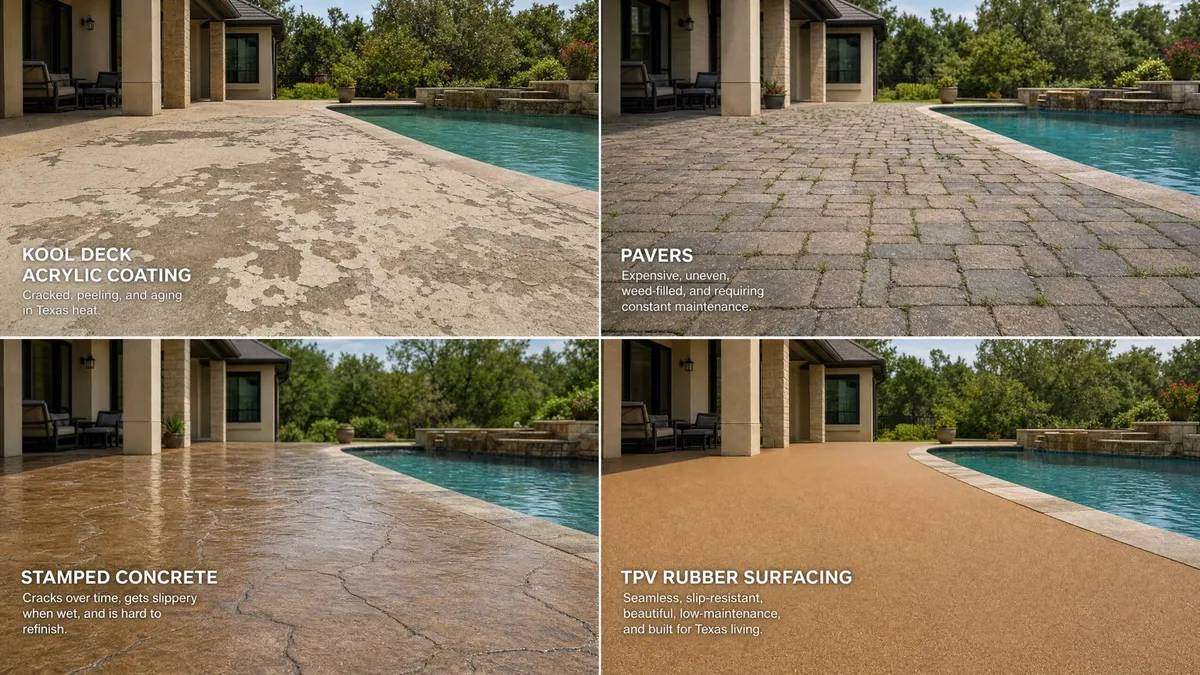
1. Acrylic Coatings (Kool Deck / Paint)
When it may fit: An owner who wants a cosmetic refresh and has a stable base.
Questions to ask: How will the coating handle existing cracks, pool traffic, drainage, and future maintenance?
2. Stamped Concrete Overlays
When it may fit: An owner who wants a decorative concrete appearance and has a suitable base.
Questions to ask: What preparation and maintenance does the specific system require, and how will repair areas blend with the surrounding finish?
3. Concrete Pavers and Natural Stone
When it may fit: An owner who values a modular stone or paver appearance.
Questions to ask: Are the joints, edges, and base stable? What maintenance is expected around pool water, weeds, and settlement?
4. TPV Poured-in-Place Rubber
When it may fit: An owner who wants a seamless, hand-troweled surface over suitable stable hardscape.
Questions to ask: Is the base suitable for an overlay? How will drainage, cracks, edges, pool chemicals, and use affect the proposed system?
The Bottom Line
The right choice is project-specific. Avoid choosing solely by an initial number; compare the actual scope, material system, surface preparation, drainage plan, and warranty terms.
Get a Project-Specific Estimate
Use our project planning guide and the project planner on our homepage, then contact ARS for a project-specific evaluation.
Schedule Your Free Consultation Today
Frequently Asked
Why does ARS specify TPV instead of EPDM rubber?
ARS specifies TPV for its outdoor projects and does not install EPDM. Material names alone do not establish performance or lifespan; compare the complete material-and-binder system, intended exposure, base preparation, maintenance, and installer specification.
Will I ever need to reseal or refresh my rubber pool deck?
Care needs depend on the installed system, use, exposure, maintenance, and site conditions. ARS can explain the project-specific care guidance for a proposed installation; no universal maintenance or lifespan promise applies to every outdoor surface.
How does rubber surfacing affect my property value?
A surface upgrade may change the appearance and use of an outdoor area, but ARS does not promise a particular resale, appraisal, or property-value outcome.
See If Rubber Surfacing Is Right for Your Project
Share your contact info below — Affordable Rubber Surfacing will follow up by text for project photos and details, then schedule a free consultation.