When researching poured-in-place rubber surfacing for a pool deck, patio, or play area, you’ll typically encounter three material terms: TPV, EPDM, and SBR. They are not interchangeable — each is a different rubber category that can appear in different installed systems.
The complete system—not an acronym alone—matters. Granules, binder, intended use, base preparation, exposure, maintenance, and installation quality all affect a finished project.
Affordable Rubber Surfacing specifies TPV, not EPDM or SBR, for its residential and commercial outdoor installations. This guide explains the product-category differences and the questions a buyer should ask before choosing a system.
What Is EPDM Rubber?
EPDM (Ethylene Propylene Diene Monomer) is a synthetic-rubber material term used in a variety of products and installed systems.
EPDM systems vary by manufacturer, formulation, installation, and exposure. ARS does not install EPDM; it specifies TPV for its outdoor work because it considers TPV the better material choice for its standard.
What Is SBR Rubber?
SBR (Styrene-Butadiene Rubber) is a synthetic rubber commonly used in recycled rubber products because it’s economical and has good abrasion resistance. It’s a legitimate material for many applications, including as a base or infill layer in some surfacing systems.
By itself, SBR has poor UV and ozone resistance. Without protective additives, published materials research shows it can degrade, crack, discolor, and lose elasticity when exposed to direct sunlight over time [2] — which is why it is generally not recommended as the exposed, UV-facing surface layer for an outdoor pool deck or patio. Some lower-cost surfacing systems use SBR as a way to reduce material cost; that tradeoff is worth asking about directly rather than assuming every “rubber surfacing” quote uses the same underlying material.
ARS does not specify SBR for its outdoor surface layer for this reason.
What Is TPV Rubber?
TPV stands for thermoplastic vulcanizate. It is the rubber granule material ARS uses in its poured-in-place systems.
What ARS installs: TPV rubber granules mixed with aliphatic polyurethane resin and hand-troweled over a prepared, stable substrate.
TPV is produced by dynamically vulcanizing (cross-linking) rubber particles within a thermoplastic matrix, rather than using EPDM rubber alone. Published materials-science research on this class of material has found that TPV shows better long-term stability in tension and compression-set behavior under accelerated aging than standard EPDM, and that EPDM’s own oxidation resistance is a known limiting factor in its long-term weathering performance [1]. That is one of the material-science reasons ARS specifies TPV for outdoor installations, though real-world performance still depends on the full system, exposure, and installation quality.
Head-to-Head: TPV vs. EPDM in Texas
1. Material Specification
TPV and EPDM are not interchangeable labels for the same installed system. Ask what rubber granules and binder will be used, whether the system is intended for outdoor exposure, and how the installer prepares the substrate. ARS’s answer is TPV with aliphatic polyurethane resin.
2. Material Quality Is Not a Footnote
The name on the granule is not the whole story. In a poured-in-place surface, the granules must be clean, dry, appropriately graded, and compatible with the binder. Excess dust, oils, or processing residue can interfere with the bond between granule and resin; poor binder selection, incorrect mix ratios, inadequate coverage, or rushed preparation can lead to granule loss or an uneven finish.
That is why ARS does not treat a lower-cost rubber proposal as an apples-to-apples match. Ask for the full material specification, technical data for both granules and binder, the proposed preparation steps, and who will actually perform the installation.
3. Color and Outdoor Exposure
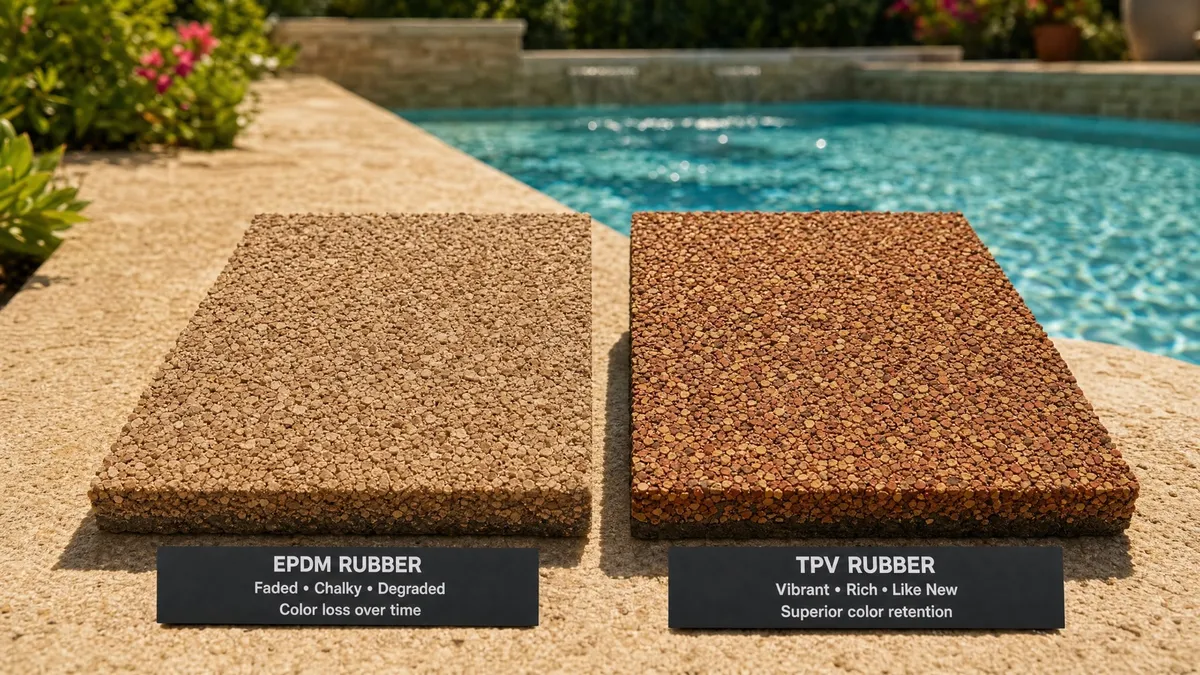
Color consistency and long-term appearance are system questions. Granule formulation, pigment quality, UV package, binder type, mix quality, and exposure all matter. Some EPDM systems can show inconsistent color, surface hardening, crumbling, or loss of granules over time; those outcomes may stem from material grade, binder compatibility, preparation, or workmanship rather than the EPDM label alone.
ARS specifies TPV with an aliphatic polyurethane resin because it is the premium exterior system the company has selected for its outdoor standard. That is a deliberate material-and-installation choice, not a claim that every EPDM product or every other installer will perform the same way.
4. Outdoor Use and Site Conditions
Heat, direct sun, pool chemicals, drainage, cleaning routines, and movement in the underlying surface affect any outdoor installation. Rubber surfacing is an overlay, not a fix for failing concrete. ARS evaluates those conditions before recommending a project.
5. Price Versus Specification
ARS deliberately uses TPV instead. Comparing bids means comparing the complete material system, preparation, project scope, warranty terms, and the condition of the base—not a material acronym or price per square foot alone. A lower initial price may reflect lower material grade, a different binder, less preparation, fewer edge details, or a different responsibility for future repairs. For more on what a lower-priced quote can mean down the road, see our guide on cheap rubber surfacing red flags.
Questions to Ask an EPDM or TPV Installer
- What exact granule product, binder, and color blend are specified?
- Is the binder aliphatic for this exterior color and exposure?
- How are granules stored, screened, and kept free of excessive dust or contamination?
- What substrate preparation, crack treatment, and edge details are included?
- Who is performing the work: the estimating company, its own team, or a subcontractor?
- What does the workmanship warranty cover, and what site or material conditions are excluded?
The Affordable Rubber Surfacing Standard
We’re often asked if we install EPDM. The answer is no.
We use TPV rubber granules with aliphatic polyurethane resin for suitable outdoor pool decks, patios, play areas, walkways, and select commercial spaces. Pricing, lifespan, and performance are always project-specific; maintenance, weather, use, and base conditions all matter.
Ready to Upgrade Your Surface?
If you’re considering a pool deck resurfacing project, ask about the durability tradeoffs of TPV versus other materials for your specific site.
Contact Affordable Rubber Surfacing to explore our custom color blends and learn how we can evaluate your outdoor space.
Schedule Your Free Consultation Today
References
[1] Guo et al. “Thermal ageing of PP-EPDM thermoplastic vulcanizate: Multiscale study and kinetic modeling.” Polymer Degradation and Stability, ScienceDirect. https://www.sciencedirect.com/science/article/pii/S0141391025003076
[2] “UV degradation of styrene-butadiene rubber versus high density poly(ethylene) in marine conditions studied by infrared spectroscopy, micro indentation, and electron spin resonance imaging.” Polymer Degradation and Stability, ScienceDirect. https://www.sciencedirect.com/science/article/abs/pii/S0141391018302660
Frequently Asked
Is TPV rubber safe for children and pets?
Suitability depends on the full installed system, the use of the area, and any project-specific requirements. ARS can explain the TPV-and-binder system it specifies, but property owners should not assume a material alone meets a particular safety, accessibility, or fall-height requirement.
How does TPV compare to EPDM in DFW's climate?
ARS specifies TPV for its outdoor projects; it does not install EPDM. TPV and EPDM can each vary dramatically by grade and system. ARS recommends comparing the complete granule-and-binder specification, outdoor UV and color data, cleanliness/quality controls, base preparation, and installer accountability—not just the acronym on a bid.
Can TPV be customized to match my home's exterior?
Color and finish options are reviewed as part of the project evaluation. Availability and the appropriate selection depend on the material system and project conditions.
Does TPV get hot in the sun?
No outdoor finish stays cool in direct Texas sun. Color, shade, time of day, and local conditions all matter, so ARS recommends reviewing samples in the intended location rather than relying on a blanket heat claim.
Is TPV the same as TPE?
No. TPE is a broad label for thermoplastic elastomers, while TPV is thermoplastic vulcanizate. Material names alone do not establish that two systems perform the same way; compare the complete granule-and-binder system, its intended exposure, and the installer’s specification.
Which is better, TPV or TPE?
There is no universal winner across every rubber product. For the outdoor poured-in-place projects ARS accepts, the company specifies TPV because that is the material system it has selected for its outdoor standard.
What is SBR rubber, and is it used in rubber surfacing?
SBR (Styrene-Butadiene Rubber) is a common, economical synthetic rubber sometimes used in recycled rubber products or as a base/infill layer. By itself it has poor UV and ozone resistance and can degrade, crack, or discolor with outdoor sun exposure over time, which is why ARS does not specify it as the exposed top layer for an outdoor pool deck or patio.
Why do some rubber surfacing quotes cost less than others?
Price differences often come down to the underlying material. TPV, EPDM, and SBR have different raw material costs, and some lower-cost quotes may substitute SBR or a lower grade of EPDM for the exposed surface layer. Ask any installer to name the exact granule material, not just 'rubber surfacing,' before comparing prices.
See If Rubber Surfacing Is Right for Your Project
Share your contact info below — Affordable Rubber Surfacing will follow up by text for project photos and details, then schedule a free consultation.