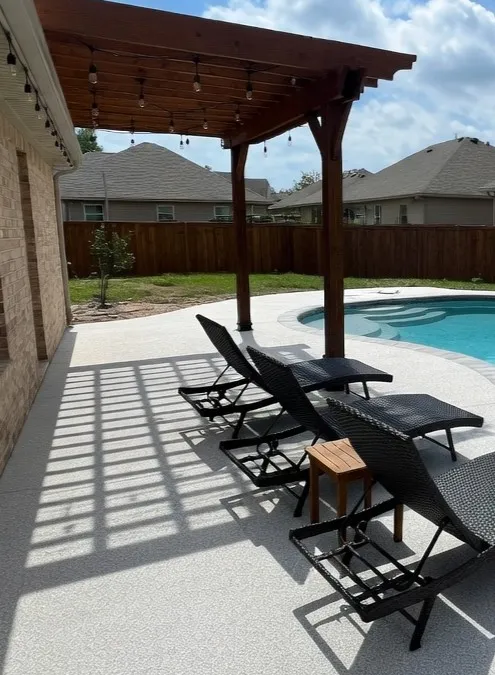
A pool deck is a wet, high-use part of the backyard. When concrete has cracks, worn coatings, uneven joints, or drainage issues, it is reasonable to look at resurfacing options. Poured-in-place rubber surfacing can be one option, but it is not a universal answer and it is not a structural repair.
This guide is a practical way to evaluate whether a hand-troweled TPV rubber surface is worth discussing for your DFW pool deck. It is meant to help you ask better questions before choosing any material or installer.
Start with the existing surface, not the finish color
The condition beneath a new surface matters. Before anyone recommends an overlay, ask for an evaluation of:
- Cracks, including whether they appear stable or are showing ongoing movement
- Low spots, drainage routes, and places where water collects
- Loose, spalled, or deteriorated concrete
- Expansion joints, edges, steps, coping, and transitions to other surfaces
- Access for materials and installation equipment
An overlay may be appropriate for a stable base, but it does not make an unstable base structurally sound. Affordable Rubber Surfacing reviews the surface, drainage, and project edges before recommending an installation path. For a broader comparison, see resurfacing versus replacing a cracked pool deck.
What poured-in-place rubber means
For ARS projects, the surface system uses TPV rubber granules mixed with an aliphatic polyurethane resin and hand-troweled over a suitable prepared surface. The finished appearance, texture, and drainage behavior depend on the selected system, the existing base, site conditions, and installation details.
TPV and EPDM are material terms, not automatic quality grades. If you are comparing proposals, ask each installer to identify the granule material, binder, intended use, care guidance, and the warranty that applies to the work. Our TPV material guide explains the questions worth asking.
Evaluate wet-area use with specific questions
No surface can remove the need for pool-area supervision, good drainage, or sensible behavior around water. Instead of accepting a generic “slip-proof” claim, ask the installer how the proposed system is specified for a wet outdoor area and what site conditions could affect it.
Useful questions include:
- What texture and installation details are proposed for this pool deck?
- How will existing slopes, drains, and water flow be handled?
- What preparation is needed around cracks, joints, steps, and coping?
- What care instructions apply after installation?
- What does the workmanship warranty cover, and what does it not cover?
ARS provides a two-year workmanship warranty for issues caused specifically by installation mistakes. It does not turn the surface into a safety guarantee or cover conditions outside the installation work.
Treat heat comfort as a sample-and-site decision
Direct Texas sun affects every outdoor surface. A light color, shade pattern, exposure, and time of day can make a significant difference in how a pool deck feels. It is more useful to look at samples and talk through your actual backyard than to rely on a promise that one material will always feel cool.
If bare-foot comfort is a major concern, share photos showing the pool orientation, shade, and surrounding materials during your consultation. That gives the installer the context needed to discuss options honestly.
Plan for maintenance before installation
Ask for care guidance in writing. The right routine depends on the material system, the project environment, pool chemicals, landscaping debris, and the chosen finish. Good questions to cover are:
- Which cleaners and tools are appropriate?
- How should spills, leaves, and organic debris be handled?
- Is pressure washing appropriate for this system, and if so, under what guidance?
- What should the owner watch for around joints, edges, or base movement?
Maintenance is not a substitute for proper installation, but it is part of protecting any outdoor finish over time.
Get a project-specific recommendation, not a generic price
The most useful next step is a conversation about your actual pool deck. ARS can review photos, approximate square footage, the existing surface, drainage concerns, and the areas you want to improve. When appropriate, an in-person evaluation can confirm whether an overlay is a fit.
Use the project planner to share rough square footage, then contact Affordable Rubber Surfacing to start the evaluation.
Frequently Asked
Can rubber surfacing be considered over cracked concrete?
Sometimes, if the existing base is stable and appropriate for an overlay. A site evaluation should look at the crack pattern, movement, drainage, edges, and any needed repairs before an installer recommends a path.
How long does a rubber pool deck last?
There is no universal lifespan. UV exposure, traffic, pool chemicals, cleaning habits, base movement, weather, color choice, and installation quality all affect service life. ARS does not promise a lifespan without understanding the project.
How is poured-in-place rubber maintained?
Keep leaves and debris from building up and follow the material system's care guidance. Before choosing a cleaner or pressure-washing approach, ask the installer for project-specific recommendations.
Will rubber surfacing stay cool in Texas sun?
No outdoor finish stays cool in direct Texas sun. Color, shade, time of day, and local conditions all matter. Ask to review real samples in the intended location rather than relying on a blanket heat claim.
How much does rubber pool-deck surfacing cost?
Pricing is project-specific. Surface condition, preparation, drainage, access, layout, and design all affect scope. ARS reviews photos and site details before providing a quote.
How do I find a rubber pool deck surfacing installer near me in DFW?
Ask any installer serving your area for the specific material system, base-preparation process, and workmanship warranty terms, not just a price. ARS installs poured-in-place TPV rubber pool deck surfacing throughout the Dallas-Fort Worth Metroplex and can review your specific site.
See If Rubber Surfacing Is Right for Your Project
Share your contact info below — Affordable Rubber Surfacing will follow up by text for project photos and details, then schedule a free consultation.